

For example, we found cases in which risks to the federal budget have not been fully taken into account (No. 2), the organisation of public bodies was inefficient (No. 9) and procurements or projects proved useless (No. 10 and No. 14).
In several cases, funding efforts and stimulus packages did not achieve set goals: The Government evenly spread funds earmarked for the digital transformation of enterprises across the board instead of applying appropriate criteria (No. 6). In another case, the Government gave some €88 million from the Forest Climate Fund to projects which failed to actually protect forests and the climate (No. 18).
When it comes to the revenue budget, the Government should call into question the generous motor vehicle tax privileges (No. 19) and, in fighting cross-border tax evasion, effectively and consistently impose a penalty for non-compliance with reporting obligations of financial institutions (No. 5).
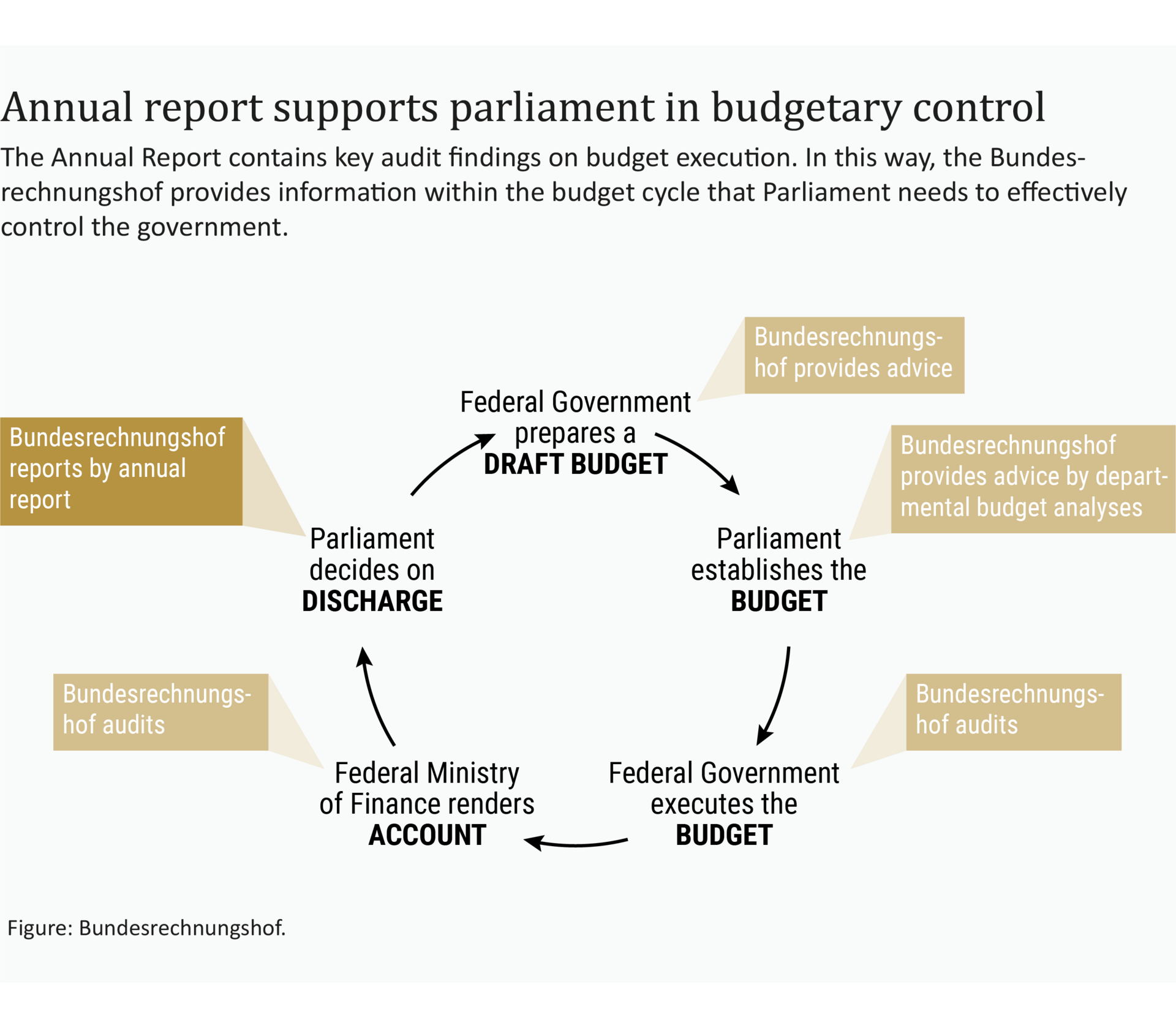
The annual report lays the groundwork for the decision to grant discharge to the Government.
After the closure of the financial year, the Government is held to account by Parliament and the Federal Council of Constituent States. Following submission of the annual financial accounts, Parliament and the Federal Council decide on granting discharge for the respective financial year.
Our annual report provides a key cornerstone of this procedure. The annual report deals with the Government’s revenue, expenditure, assets and liabilities. Our annual report encompasses recommendations to help address shortcomings and use budget funds more efficiently and effectively.