

In December 2023, we presented our 2023 Annual Report. This annual report is now supplemented by a spring report. The spring report contains nine reporting items including examples in which federal financial management was not targeted, inefficient and ineffective.

Time for more efficiency: 2023 Annual Report supplemented by a spring report
The reporting items in the current sprint report show examples where the Federal Government delays necessary projects and implements parliamentary decisions too hesitantly. We found that the Federal Ministry for Housing, Urban Development and Building delays the establishment of an overarching real estate database, thus jeopardising not only the coordination of federal refurbishment projects but also the timely implementation of the EU Energy Efficiency Directive (No. 35). In the portfolio of the Federal Ministry for Digital and Transport, there is also little targeted action. The Ministry delays the winding up of the Federal Railways Fund despite a decision already taken by the Public Accounts Committee (No. 30).
In addition, there is again room for improvement in implementing support programmes: The Federal Ministry for Economic Affairs and Climate Action does not ensure that sufficient staff is available for processing funding applications promptly. As a consequence, the burden for the Federal Office for Economic Affairs and Export Control is too high. This does not only jeopardise target achievement but also the disbursement of funds due to the delayed processing of applications and as a result, the acceptance for support programmes in the population (No. 29).
Two reporting items concern the German Armed Forces. The Bundeswehr faces enormous challenges: despite the Bundeswehr Special Fund, it is lacking sufficient budget funds to ensure Germany’s defence capability. At the same time, the Bundeswehr has been running ten technical schools with a continued capacity utilisation of only 50 per cent since 2005, despite our repeated criticism. We recommend again that the Bundeswehr close redundant schools (No. 32). In another case, the Bundeswehr pays a price which exceeds the price limit laid down in the framework agreement of the Federal Government by a factor of 15 for a commercially available battery that runs headsets and microphones for communication support. We urge the Bundeswehr to strictly apply the principle of economy (No. 33).
The Government also needs to act on the revenue side to achieve better results. The Federal Finance Ministry imposes itself unnecessary restrictions in digital taxation: The Ministry granted unjustified rights of veto to the economy which render the statutory e-accounting for the taxation of enterprises useless. Instead of terminating this undue exertion of influence, the Ministry intends to introduce a parallel procedure for taxation (No. 28).
Annual report prepares decision on granting discharge to Federal Government
After closure of each financial year, the Federal Government is held to account by Parliament and the Federal Council of Constituent States. Following submission, Parliament and the Federal Council of Constituent States decide on granting discharge to the Federal Government for the respective financial year.
Our annual report provides an important basis for the discharge procedure. The report analyses the Federal Government’s revenue and expenditure, assets and liabilities. The report also provides recommendations on how to address shortcomings and on how to use budget funds in a more efficient and effective manner.
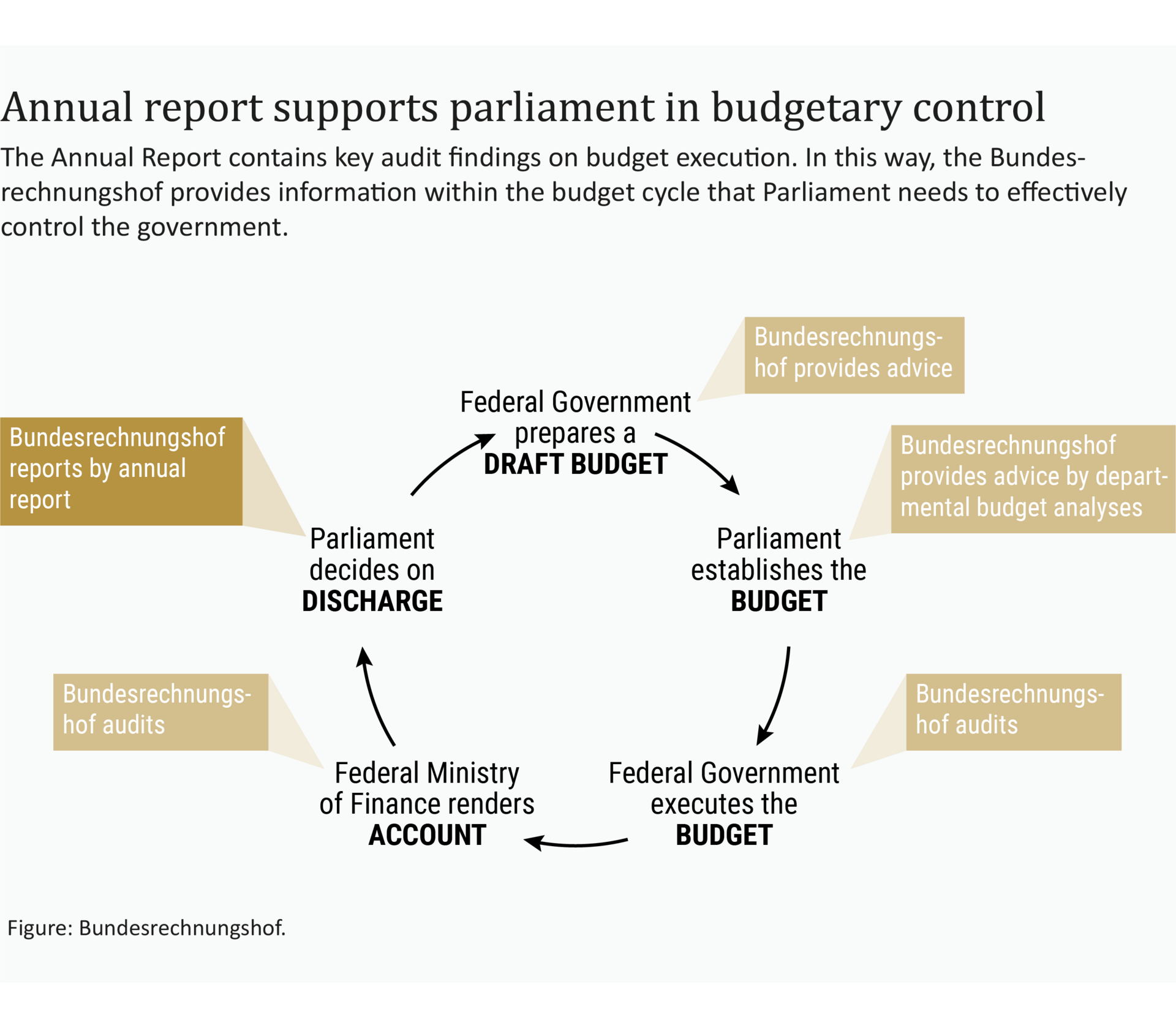
The current spring report supplements the annual report by providing nine further reporting items that show where federal financial management needs improvement.
The Public Accounts Committee, a sub-committee of German Parliament’s Budget Committee, will deliberate on our annual report during the first six months of 2024. As a rule, the deliberation goes along with the demand addressed to the Federal Government to implement our recommendations.
Downloads
Annual report - Supplementary Report (Short info in English, long version only available in German)